
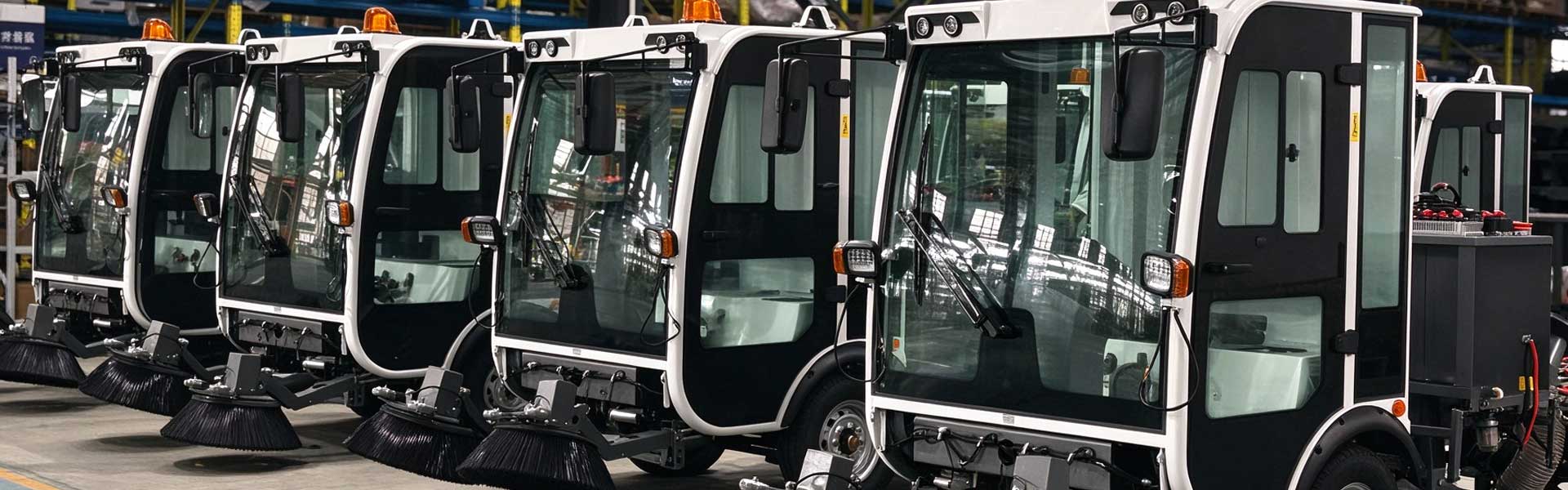
Warehouse cleaning looks simple until you actually try to clean a busy warehouse.
Forklifts move through aisles. Pallets are constantly loaded and unloaded. Cardboard, plastic, dust and packaging materials accumulate around loading areas. Tire marks appear on concrete floors, while fine dust can spread across storage zones.
This means choosing a warehouse floor sweeper for sale is not simply about finding the machine with the largest brush or highest advertised cleaning capacity.
A better approach is to start with six practical requirements:
Actual cleaning area
Type of debris
Aisle and access width
Required cleaning productivity
Battery/runtime
Dust and debris collection capacity
These factors are increasingly emphasized in current warehouse sweeper buying guidance.
1. How Much Floor Do You Actually Need to Sweep?
Start with the area that needs to be cleaned—not the total size of the warehouse.
For example:
Total warehouse: 20,000 m²
But only:
12,000 m²
may require daily sweeping.
The remaining area may be:
Offices
Racking footprint
Equipment areas
Restricted zones
Outdoor storage
Areas cleaned on another schedule
Therefore, your machine should be selected around the 12,000 m² daily route, not the full 20,000 m² building.
Current warehouse sweeper guidance similarly recommends focusing on the floor that must actually be swept during the available shift.
Calculate Your Required Cleaning Productivity
Suppose:
Daily cleaning area = 12,000 m²
and:
Available cleaning time = 3 hours
The minimum practical productivity is:
12,000 ÷ 3 = 4,000 m²/h
But you should not automatically buy a sweeper rated at exactly 4,000 m²/h.
Real warehouse cleaning includes:
Turning
Avoiding forklifts
Passing around pallets
Emptying the hopper
Battery charging
Operator breaks
Narrow areas
Repeated passes
Theoretical productivity and practical productivity can be significantly different.
A machine with additional capacity provides a useful operating margin.
2. What Kind of Debris Are You Cleaning?
This may be the most important question for a warehouse.
Not all warehouse dirt is the same.
Light Warehouse Debris
Examples:
Dust
Paper
Plastic film
Small packaging debris
Fine dirt
A standard battery-powered sweeper may be sufficient.
Heavy Industrial Debris
Examples:
Metal particles
Wood chips
Gravel
Heavy dust
Production waste
Larger packaging debris
A more robust industrial configuration may be necessary.
Example
Consider two warehouses.
Warehouse A
E-commerce distribution center:
Cardboard
Plastic
Fine dust
Paper
Warehouse B
Metal parts warehouse:
Metal particles
Fine industrial dust
Packaging debris
Forklift tire dirt
Both facilities may be 10,000 m², but they do not necessarily need the same sweeper.
This is why an industrial floor sweeper supplier should know the debris type before recommending a model.
3. Measure the Narrowest Aisle
This is one of the easiest requirements to overlook.
Imagine a warehouse where most aisles are:
4 meters wide
but one section is only:
2.4 meters wide
A large ride-on sweeper may perform very well in the 4-meter aisles but become difficult to maneuver in the 2.4-meter area.
Therefore, measure:
Narrowest aisle
Door width
Turning area
Loading dock access
Elevator dimensions
Ramp width
Storage area
Current warehouse sweeper guidance specifically recommends measuring clear aisle width and considering turning requirements rather than selecting equipment from total floor area alone.
Ride-On or Walk-Behind Sweeper?
For a large warehouse with long straight aisles, a ride-on sweeper can significantly reduce operator walking.
For example:
Warehouse size: 15,000 m²
Cleaning route: 10,000 m²/day
Daily cleaning time: 3–4 hours
A ride-on machine may be appropriate if the aisles are sufficiently wide and open.
On the other hand:
Warehouse size: 4,000 m²
Narrow aisles
Many obstacles
A walk-behind sweeper may provide better maneuverability.
For larger logistics centers, warehouses and industrial facilities, ride-on sweepers are commonly considered when long routes and higher daily coverage are required.
4. Match the Sweeper to Your Cleaning Window
Suppose your warehouse operates:
7:00 AM–7:00 PM
and forklifts are constantly active.
You may only have:
6:00 AM–7:00 AM
for floor cleaning.
That means your machine needs to complete the required route within:
1 hour
If the daily cleaning area is:
5,000 m²
then the required practical productivity is:
5,000 m²/h
This is a much more useful specification than saying:
“We have a 10,000 m² warehouse.”
The cleaning window determines the machine size.
5. Check Battery Runtime and Charging
For electric warehouse sweepers, battery performance matters because the machine may be expected to work throughout the cleaning window.
For example:
Required cleaning time: 4 hours
If the machine provides only around 2 hours of practical operating time under the actual workload, the operator may need to interrupt the job for charging or battery replacement.
This creates:
Lost cleaning time
Lower productivity
Additional labor
More complicated scheduling
For a warehouse operating daily, it is usually better to match battery configuration to the actual shift requirement.
Also confirm:
Battery type
Charging time
Charger specification
Battery replacement cost
Availability of replacement batteries
6. Check Dust and Debris Collection Capacity
A sweeper is only useful if it can collect the debris generated by your warehouse.
Imagine a loading area producing:
100 kg of mixed debris per day.
If the machine has a relatively small debris hopper, the operator may need to stop repeatedly for dumping.
A larger hopper can reduce interruptions, but it also increases machine size and weight.
Therefore, hopper capacity should be matched to the actual debris volume.
The same principle applies to dust control.
If the warehouse generates significant fine dust, the buyer should ask about the machine's dust-control system and filter maintenance rather than looking only at brush width.
A Practical Warehouse Example
Consider a logistics center with:
18,000 m² total floor area
Daily cleaning requirement:
12,000 m²
Available cleaning window:
3 hours
Floor:
Concrete
Debris:
Dust
Cardboard
Plastic
Forklift tire dirt
Narrowest aisle:
3.0 m
Daily operation:
1 shift
Based on this information, the buyer can tell the supplier:
“We need an electric ride-on warehouse sweeper capable of practically covering approximately 12,000 m² within three hours. The narrowest aisle is 3 meters, the floor is concrete, and the main debris is dust, cardboard and packaging waste.”
This is far more useful than simply asking:
“How much is your biggest sweeper?”
Don't Buy Based Only on Advertised Square Meters per Hour
Suppose Supplier A advertises:
10,000 m²/h
and Supplier B advertises:
8,000 m²/h
It might seem obvious that Supplier A is better.
But what happens if:
Supplier A has a larger turning radius?
Supplier A cannot enter your narrow aisles?
Supplier A requires frequent hopper dumping?
Supplier A has shorter battery runtime?
Supplier B has better maneuverability?
The second machine could potentially complete your actual route more efficiently.
This is why practical productivity is more useful than headline productivity.
A recent warehouse sweeper buyer guide specifically warns buyers not to select equipment only from published path width or square-meter-per-hour specifications because real warehouse conditions include turning, dumping, dust control and traffic constraints.
Sweeper Width: Bigger Is Not Always Better
Consider:
Machine A
Cleaning width: 800 mm
Machine B
Cleaning width: 1,300 mm
Machine B can potentially cover a larger area per pass.
But if the warehouse contains:
2-meter aisles
Tight corners
Pallet staging areas
Narrow loading zones
Machine A may be easier to operate.
Now consider a distribution center with:
5-meter-wide open aisles
Machine B may provide a significant productivity advantage.
Therefore, cleaning width should always be considered together with aisle width.
When Should You Choose a Ride-On Sweeper?
A ride on floor sweeper for warehouse applications is especially attractive when:
Daily cleaning area is large
Routes are long
Aisles are relatively wide
Operators work for several hours
The facility has large open zones
Manual walking would reduce productivity
For example, a 15,000 m² logistics center with 4–5 meter aisles can be a strong candidate for a ride-on sweeper.
The operator can cover long routes without continuously walking behind the machine.
When Is a Walk-Behind Sweeper Better?
A walk-behind machine may be more appropriate when:
Warehouse area is smaller
Aisles are narrow
There are many obstacles
Cleaning zones change frequently
The buyer needs a lower initial investment
The machine must be easy to transport
The key is to match the equipment to the warehouse layout rather than automatically upgrading to ride-on equipment.
Don't Forget the Loading Dock
Warehouse buyers often focus on storage aisles and forget the loading area.
But loading docks can be among the dirtiest parts of the facility.
They may contain:
Dust
Cardboard
Plastic
Pallet fragments
Gravel
Outdoor dirt
Tire debris
If the sweeper will operate in the loading area, confirm:
Floor condition
Ramp access
Door dimensions
Outdoor/indoor transition
Debris size
Dust level
A machine designed only around clean indoor aisles may not be the best choice for heavy loading-dock debris.
Ask About Maintenance Before You Buy
For warehouse equipment, downtime can be more expensive than a slightly higher purchase price.
Ask the supplier about:
Main brush replacement
Side brush replacement
Filter cleaning
Filter replacement
Battery maintenance
Charger
Debris hopper
Spare parts
Warranty
Technical support
For international buyers, also confirm whether replacement parts can be shipped quickly to your country.
A recent commercial and warehouse scrubber/sweeper buying recommendation similarly emphasizes spare-parts availability and after-sales support when evaluating equipment.
Six Requirements to Send to Your Sweeper Supplier
Before requesting a quotation, prepare these six pieces of information:
1. Daily Cleaning Area
Example:
10,000 m²/day
2. Cleaning Window
Example:
3 hours/day
3. Floor Type
Example:
Concrete
4. Main Debris
Example:
Dust + cardboard + plastic + tire dirt
5. Narrowest Access
Example:
2.8 m aisle / 2.2 m doorway
6. Operating Requirement
Example:
Battery-powered, ride-on, one operator
Then the supplier can recommend a machine based on your actual warehouse.
Example RFQ
A buyer could send:
Application: Logistics warehouse
Total area: 15,000 m²
Daily cleaning area: 10,000 m²
Cleaning window: 3 hours
Floor: Concrete
Debris: Dust, cardboard and plastic
Narrowest aisle: 3 m
Door width: 2.5 m
Operation: 1 shift/day
Power: Electric/battery
Preferred machine: Ride-on sweeper
This gives an industrial floor sweeper supplier enough information to recommend the appropriate machine class and configuration.
The Right Warehouse Sweeper Is About Route Coverage
When choosing a warehouse floor sweeper for sale, don't start with:
“Which model is the biggest?”
Start with:
“How much floor must we clean, what is on the floor, how wide are the routes, and how much time do we have?”
For a small warehouse with narrow aisles, a compact walk-behind sweeper may be the most economical choice.
For a large distribution center with long, open aisles, a ride on floor sweeper for warehouse applications can provide much higher practical productivity.
And for a heavy industrial facility with large amounts of dust or debris, a heavy-duty configuration may be more appropriate.
The best machine is ultimately the one that can complete the required cleaning route within the available working window, without excessive interruptions for maneuvering, dumping or charging.
For international buyers, providing the six requirements above to the supplier is also one of the fastest ways to receive a useful quotation instead of a generic product catalog.